
The Help by Kathryn Stockett
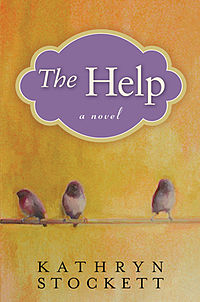
9 of 10: It seems very likely that you’ve seen or heard of The Help; it’s been a huge bestseller. Let me be one more voice in the “This is really a delightful book” crowd. This story about the Civil Rights Era in the South, on a micro-level, is terrifically readable and full of great characters. You’ll laugh, you’ll cry, you’ll go home happy.
You know what makes me paranoid? When people talk about how you can’t give any summary of a certain book without spoiling it. Because, what I’m going to say about The Help, I don’t feel like is a spoiler.
I am going to call that last paragraph “fair warning.” (Also, I just went and read some professional reviews of the book and they all gave plenty of plot summary, so I forge onward guilt free).
The Help by Kathryn Stockett
The story of The Help is set in Civil Rights-Era Jackson, Mississippi, which, as you can imagine, is an excellent time and place to be black. Or not. Most of the white people are pretty darn committed to making sure that they stay the ruling race and any attempts by others, black or white, to change that are going to be crushed in a quick and likely cruel way.
There are three main characters, each of whom you hear from alternately. One is an older black woman named Aibileen who has been a maid/nanny for a number of families over the course of her life. She’s a little bit quiet, but she’s observant and she has a lot of years of dealing with being a black woman raising a white woman’s children.
Minny is Aibileen’s dearest friend, a younger black woman, who is a tremendous cook but has a hard time keeping a job because she can’t often resist the urge to talk back (a trait which is not exactly desired among white families looking for help).
And there’s Skeeter, a white girl just graduated from college and still unmarried. Her mother takes that to mean her four-year education was a complete waste. Skeeter’s family had a black maid/nanny for most of her growing up and was extremely close to the woman, but when she returns from college, the nanny is gone and no one will tell her why or where she has gone.
Most of Skeeter’s best friends from high school are married and settled down in their hometown, and Skeeter spends a great deal of time with them, but is a little distressed when her closest friend starts really pushing a petition to get white families to put in separate bathrooms for their black help. This event, combined with the mysterious disappearance of her nanny, gets Skeeter thinking about the relationships between blacks and whites, especially when so many white children are raised, primarily, by their black nannies.
Could she possibly get some black women to talk about their experiences working for white families? She has dreams of being a writer anyway, and this seems like something that, just maybe, she could start a career with.
(I admit, I had to go back and look up all their names – I am terrible with character names, always).
There is a lot to like about this book. It is easy to be drawn in by the storyline and the characters and it’s a pretty fast read (I finished the whole thing on my way to Phoenix a few weeks ago). It’s a historical time-period I’ve been really interested in since high school, and I thought the portrayal of the events and the relationships were pretty accurately done.
The characters in The Help are really well done – they’re all pretty different and easy to tell apart (it is one of my most enormous pet peeves when there are multiple voices that all sound exactly the freaking same and I have to keep checking the chapter heading to see who is even speaking), and they’re all so likable in their own real, sometimes prickly ways.
And I was impressed by the fairly even-handedness of the topic that Stockett managed. She didn’t make one group out to be saints or one group demons. There are good and bad and goodish-baddish people on every side of the issue, and each has different motivations and reasons for being where they are on that side – hate, pride, naivete, personal experiences.
The Help is not a perfect book – there were several revelations that I felt like got strung along FAR too long or that when they were finally revealed, I felt were rather anti-climatic.
I’m sure there will be people who hate it because it’s popular (are you the same ones who haven’t read Hunger Games yet?), and some people who just genuinely don’t care for it, but I thought it was definitely worth reading. Plus, you know me. If it’s popular, I want to have read it.
Also, is it just me or do you feel especially virtuous when you return a highly-requested book to the library WELL before it is due? Oh, just me?

22 Comments